
Winchester City Directory Shelves
Start with the Winchester Public Library Local History Room. Reference staff there open doors to Winchester resident lists. They also tend Middlesex County history, town directories, newspapers, maps, yearbooks, and shelves of local-history books. The Winchester collection guide also points to the Archival Center. That archive sits in the lower level of Winchester Town Hall. The Town and the Winchester Historical Society keep it jointly. A city directory is just one tool on these shelves. A resident list may be civic census material sorted by precinct or street. A directory blends names with street, organizational, and commercial details.
The Winchester directory runs have real gaps. Selected Blue Book volumes survive. A library summary of resident lists sits alongside a separate town-directory run. Winchester never published one uninterrupted annual series. The publisher behind each 1950 through 2012 volume is not confirmed. So a missing year proves nothing about a missing household. Ask Winchester reference staff to put the volume in hand first.
| Collection | Years | Where Held | Access |
|---|---|---|---|
| Winchester Blue Book / house guide | 1895, 1905, 1912, 1914, 1916, 1918, 1919, 1922, 1924 | WPL Local History Room and Archival Center | Reference-staff access; the guide says the Archival Center is more complete |
| List of Residents Over Twenty | 1925–1970 | WPL Local History Room | Reference access; arranged by precinct, street, and alphabetically |
| List of Residents Seventeen and Older | 1971–present | Town Clerk / WPL historical collection | Current list from the Clerk; historical volumes through reference staff |
| Winchester town directories | 1950–2012 | WPL Local History Room | Reference access; publisher and volume-level details need confirmation |
| Winchester residents lists | 1901–2019 | WPL Local History Room | Collection summary; check format and missing years with staff |
| Anthony’s standard business directory | 1898/99 | WPL research guide identifies a Harvard scan | Consult the guide and scan route before relying on a page |
Note: The official summaries name these runs but stop short of proving one continuous annual publication sequence.
Winchester Directory Blue Books
The Blue Book and house-guide volumes make up Winchester's early directory shelf. These Winchester books pair resident material with societies, churches, a street directory, and a map. That mix earns its keep when a surname is common. Placing a person beside a Winchester street, club, or congregation yields a lead. A bare name match never could. One caution stands. The local guide flags an OCR rendering that reads "1816." Sequence and context point to 1916. Treat that as a scan to verify, not a new publication year.
Dates must stay pinned to every claim. The Blue Book years are selected holdings, not evidence of annual coverage between them. Anthony's 1898/99 reference book adds a separate regional snapshot. The local guide identifies its Winchester pages. It serves a narrow period well. Keep it out of the Winchester Blue Book run, where it does not belong.
| Period | Winchester directory record |
|---|---|
| 1895–1924 | Selected Blue Book / house-guide volumes documented in the local research guide |
| 1901–2019 | Resident-list coverage summarized by the library |
| 1950–2012 | Town-directory run listed by the library, with publisher details still to be checked |
Winchester Directory Resident Lists
Resident lists give Winchester a different lens than an older directory. From 1925 through 1970, the documented series is the List of Residents Over Twenty. It was arranged by precinct, by street, and alphabetically. From 1971 forward, the series becomes the List of Residents Seventeen and Older. A teenager missing from an older Winchester over-twenty list was not necessarily absent from the household.
Winchester counts eight precincts in the Secretary of the Commonwealth's 2021 precinct-map material. Keep the precinct label when copying a list entry. That matters most when a family spans neighborhoods or a street has been renamed. The Winchester Town Clerk sells a current list of residents book. Winchester library material serves historical work. A current product and an older civic list answer different questions. Never swap one for the other.
Note: A resident-list entry is a dated civic record. It is not proof of a complete household or present residence.
Reading Winchester Directory Evidence
Scanned Winchester directories rarely include their abbreviation key alongside the entries. That shapes what a reader can safely conclude. The Winchester Blue Book covers residents, societies, churches, a street directory, and a map. Yet no page proves that every entry lists a spouse, occupation, employer, owner mark, or widow notation. Symbols can vary between publishers and years. Transcribe only what the specific Winchester page shows. Photograph the title page and any key before reading meaning into a mark.
Treat this inventory as a worksheet. Its blank fields do real work. They keep unobserved Winchester information from hardening into fact through repetition.
| Volume and year | Record the edition, year, page, and any item or reel identifier visible on the source. |
|---|---|
| Name as printed | Copy spelling, initials, and punctuation exactly before adding a standardized version. |
| Household notation | Transcribe a spouse or household mark only if the inspected entry contains one. |
| Work or organization detail | Record occupation, employer, society, or church only when printed on that page. |
| Street and marks | Copy an address, street order, printed mark, or abbreviation only when its meaning is verified in the same volume. |
- Criss-cross directory
- An address-first or street-order directory, if a volume actually includes one, used to read occupants or businesses in street sequence.
- Householder index
- An index organized around a household head rather than every person who may have lived at an address.
- Abbreviation key
- The explanation of shortened labels or symbols printed in a volume. Its meaning should be taken from that edition, not assumed from another town’s directory.
Winchester Directory Companion Sources
Newspapers and yearbooks can test a Winchester directory finding, though neither replaces the directory itself. The Winchester library lists Star microfilm as 1881–present on one collection page and 1883–2019 on another. Confirm the reel span at the desk. Full-text digitization covers the Winchester Star for 1901–1993. A Winchester Press microfilm run spans 1900–1902. The Woburn and Middlesex Journal run reaches 1851–1906. A Star obituary database for 1985–2000 sits at the Winchester reference desk. Related card indexes cover portions of 1881–1986.
For online material, the digitized Winchester directory search offers a direct route.
Digitized hits work best as pointers. Use one to identify a volume or page. Keep the item link, and compare it against the library guide. A digitized match does not by itself prove the contents of an individual listing. So treat it as a lead rather than evidence.
Winchester High School yearbooks cover every year from 1950 through 2019 in print. They sit in the Winchester Local History Room. They can support a former-classmate or organization trail. A yearbook name, though, does not establish a current address in the Winchester residents directory.
Winchester Library and Archival Access
The Local History Room anchors historical research in Winchester. Reference staff there manage the library's historical collections. The library is at 80 Washington Street, Winchester, MA 01890, and its listed phone number is 781-721-7171. Come prepared. A name, an approximate year, and a known Winchester street help staff distinguish a resident list from a town directory, a newspaper reel, a census transcription, or a town report.
A second resource sits below Town Hall. The Winchester Archival Center occupies the lower level and is maintained jointly by the Town and the Winchester Historical Society. Its catalog runs on PastPerfect. The catalog can be unreachable at times. Treat that as a prompt to ask about Winchester paper files or uncataloged material, not as proof an item is missing. The Historical Society's research page also points to card indexes, Town Clerk records, permits, plats, assessments, and utility files.
For a companion route through local history, start with the Winchester Historical Society research resources. Use it alongside the library's holdings.
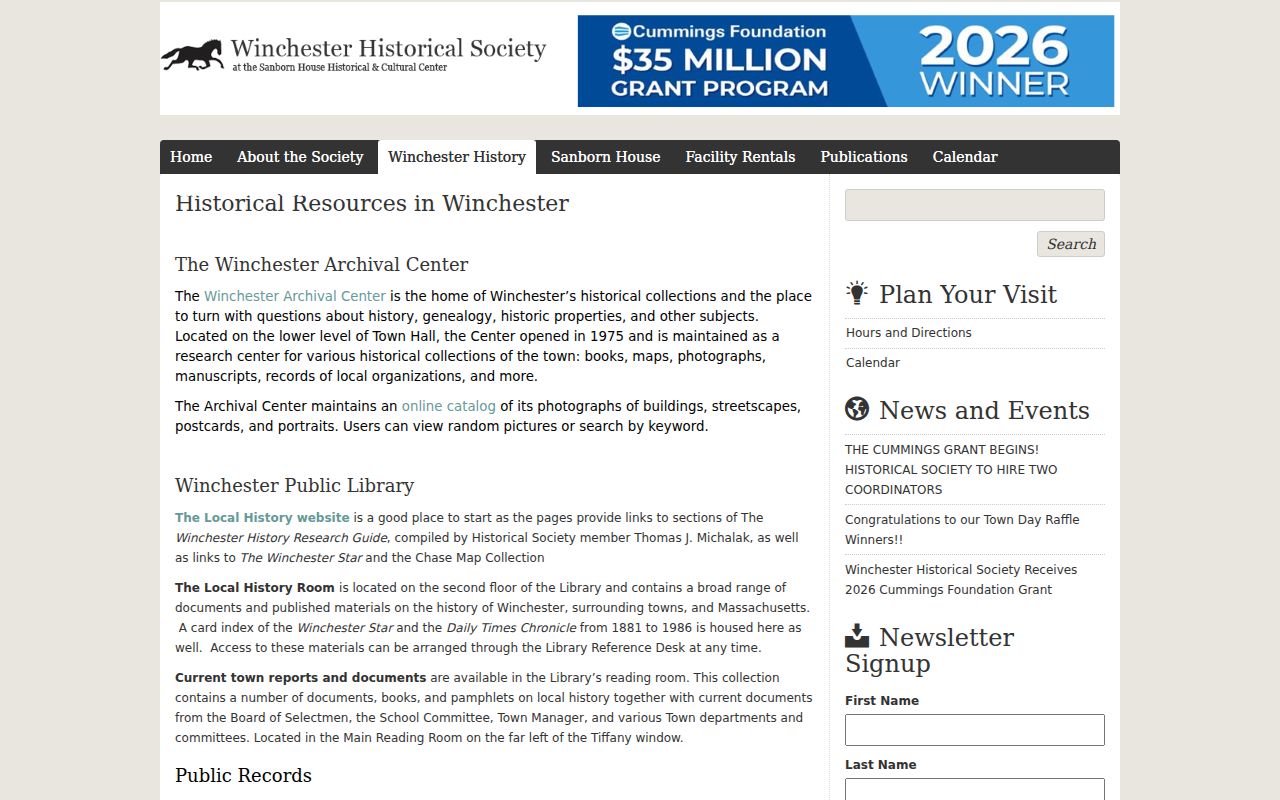
The Society's page is a lead to research materials and municipal records, not a public Winchester residents directory. Its card-index and records references pay off best after a directory year has supplied a date, street, or family name to pursue.
Trace Winchester Directory Households
A Winchester household trail works best when each source is treated as a dated observation. Start with a known name, street, and year. Follow the Winchester address as well as the surname. Initials, spelling changes, and married names can split a person's trail. Pair the directory sequence with the 1855 and 1865 Massachusetts state censuses. Released federal schedules help too. A census may identify household members whom an age-limited Winchester resident list does not show.
- Locate the nearest resident list or city directory volume and record the printed name, page, street, precinct, and year.
- Check earlier and later identified volumes, keeping every spelling variation rather than silently merging similar names.
- Compare the street or house number across the run. If a source has a street-order portion, copy its wording only after confirming the volume’s arrangement.
- Pair the dated entry with the 1855 or 1865 state census, or an available federal census, and note which people each source actually enumerates.
- Test a move, death, or relationship with an obituary index, deed, probate record, or official vital source rather than treating the directory alone as proof.
A historical directory lead often deserves a present-day cross-check. The Winchester resident lookup route keeps court, voter, vital, and property records in separate streams, which helps when a nineteenth-century household needs confirmation from a modern record set. Run the name through the resident lookup before assuming anything. A household that vanishes from one volume to the next can mean a move out of Winchester, a death the directory never noted, or simply a different listing practice that year. A missing volume is another common cause. Treat the gap as a clue, not a conclusion.
Note: Preserve the source year with every household claim, since neighboring volumes may follow different inclusion rules or arrange names differently.
Pre-1850 Winchester Directory Searches
Winchester incorporated in 1850. It drew land from Woburn, Medford, and West Cambridge. West Cambridge is now Arlington. Records for earlier Winchester-area people and places may therefore sit under a parent town. They may not sit under Winchester itself. That is normal for pre-1850 searches.
The historic names Waterfield, South Woburn, and Black Horse Village work well as search aliases. Use them when an index will not respond to Winchester. Street names shifted too. Fruit Street, now Hutchinson, is one more address clue. It helps when a deed, map, or notice skips the modern street name.
The Local History Room holds transcribed Woburn births, deaths, and marriages. It also holds marriage intentions covering 1640 through 1900. Match the event place and date first. Then choose the parent-town route that fits. A modern Winchester postal label never turns an earlier event into a Winchester record. Keep the parent town, not today's address, as the anchor.
Winchester Directory Access Limits
Winchester city directories and resident lists are historical tools, not a current household roll. A Winchester directory can omit people or apply an age threshold. It can also carry stale information. Names may be arranged in a way that resists quick matching. No distinct Winchester telephone or reverse-directory run exists in the published record. Ask the Winchester Local History Room about a genuine address-to-occupant volume. Confirm that before relying on the method.
Never infer a biological relationship, legal ownership, or a full household from one printed line. A research path can turn sensitive. Follow the custodian's access rules then. Avoid exposing anyone whose information is protected.
Use the Winchester library first for the documented historical shelf. Try the Winchester Archival Center for local paper files. The Winchester Historical Society offers research leads. For a current Winchester list, contact the Winchester Town Clerk. Do not assume the library's historical run is current. Newspaper and yearbook material add context. The State Archives and parent towns fill older gaps. Each channel answers a different date and custody question.
Winchester Directory Research Paths
Use the Winchester library first for the documented historical shelf, the Winchester Archival Center for local paper files, and the Winchester Historical Society for its research leads. For a current Winchester list, contact the Winchester Town Clerk rather than assuming the library's historical run is current. Newspaper and yearbook material add context. The State Archives and parent towns fill older gaps. Each channel answers a different date and custody question.