
Winchester Previous Residents Sources
Previous residents research works best as an era-by-era trail. Recorded land can establish a transfer, but it cannot by itself show who occupied the property. The local historical collections bring in listed adults and street context. House-history materials help test when a structure or lot changed. Start with the most recent dated parcel and deed evidence, then move backward only when the address, legal description, or plan continues to match.
| Source | Years It Covers | Where Held | What It Shows |
|---|---|---|---|
| Middlesex South recorded-land index | 1974 to present; images generally 1986 to present | Middlesex South Registry / MassLandRecords | Transfers, grantors, grantees, legal descriptions, and recording references |
| Grantor Index PDFs | 1896 to 1973 | Middlesex South Registry | Older seller-side leads for the backward deed chain |
| Blue Books and house guides | Selected years, 1895 to 1924 | Winchester Public Library and Archival Center | Residents, societies, churches, street directory, and map context |
| Resident lists and town directories | Resident lists 1901 to 2019; directories 1950 to 2012 | Winchester Public Library / Town Clerk | Historical street, precinct, and name context with changing age thresholds |
| Building and house-history evidence | Permits from about 1924 onward; 1979 local survey | Building Department, Historical Commission, and local collections | Work history, construction context, plans, and some owner history |
The Middlesex South Registry search is the best first stop for a recent transfer. For a household question, use the deed date to choose nearby resident-list, directory, newspaper, or census years. A directory entry is a historical clue, not proof of current occupancy or complete household membership.
Winchester Address Records First
Begin with a current parcel card in Winchester Patriot Properties. Save the taxkey, location, owner name, sale date, sale price, and any book or page field. Then open the Town GIS to compare the PROP_ID, SITE_ADDR, owner field, and visible parcel polygon. A sale date is a lead to a deed, not the deed itself.
Keep location and owner mailing information as separate dated fields. The assessor’s site address identifies the parcel. A mailing address can help distinguish a recorded owner, especially where a trust or entity appears, but it does not establish that the owner lived at the property. Property tax records also do not list every person who may have been part of a past household.
Winchester Deed Chain Backward
A title trail moves from the present purchase toward earlier transfers. Search the current owner as the grantee, the person or entity that received the property, using the Winchester town filter and an appropriate date range. Open the instrument, then confirm the lot, plan, legal description, or other parcel details. The seller named there becomes the next person to search as an earlier grantee. That repeatable comparison is safer than matching a surname alone.
- Capture the current parcel identifier, site address, owner, visible sale information, and legal clues from Patriot and Town GIS.
- In MassLandRecords, search the current owner as grantee around the likely purchase date, with Winchester selected.
- Open the deed and compare its legal description, plan reference, book and page, or document information with the parcel.
- Search the deed’s grantor as an earlier grantee, expanding the date range while preserving the same property controls.
- When the modern name index ends, continue with the older Grantor Index PDFs and then the Registry’s deed-book or office research path.
- Grantor
- The party giving or selling an interest in a recorded document.
- Grantee
- The party receiving or buying that interest. A backward chain searches each seller as a prior buyer.
- Chain of title
- The sequence of recorded transfers tied to one parcel, tested by dates and property descriptions.
- Legal description
- The lot, plan, metes-and-bounds, or certificate wording that identifies land when a street number is absent or has changed.
Winchester Grantor Index PDFs
The modern recorded-land name index begins in 1974, and deed images are generally available from 1986. That does not mean earlier deeds vanished. In October 2025, Middlesex South announced free online Grantor Index scans for 1896 through 1973. They extend the seller-side research path into an earlier period and should be used with the grantee index, deed books, and the property’s legal description.
See the Registry’s Grantor Indices now online announcement before opening the year folders. The historic PDFs are a research bridge, not a complete statement of every document’s availability. Registered Land follows a separate certificate and document-number system dating from 1899.
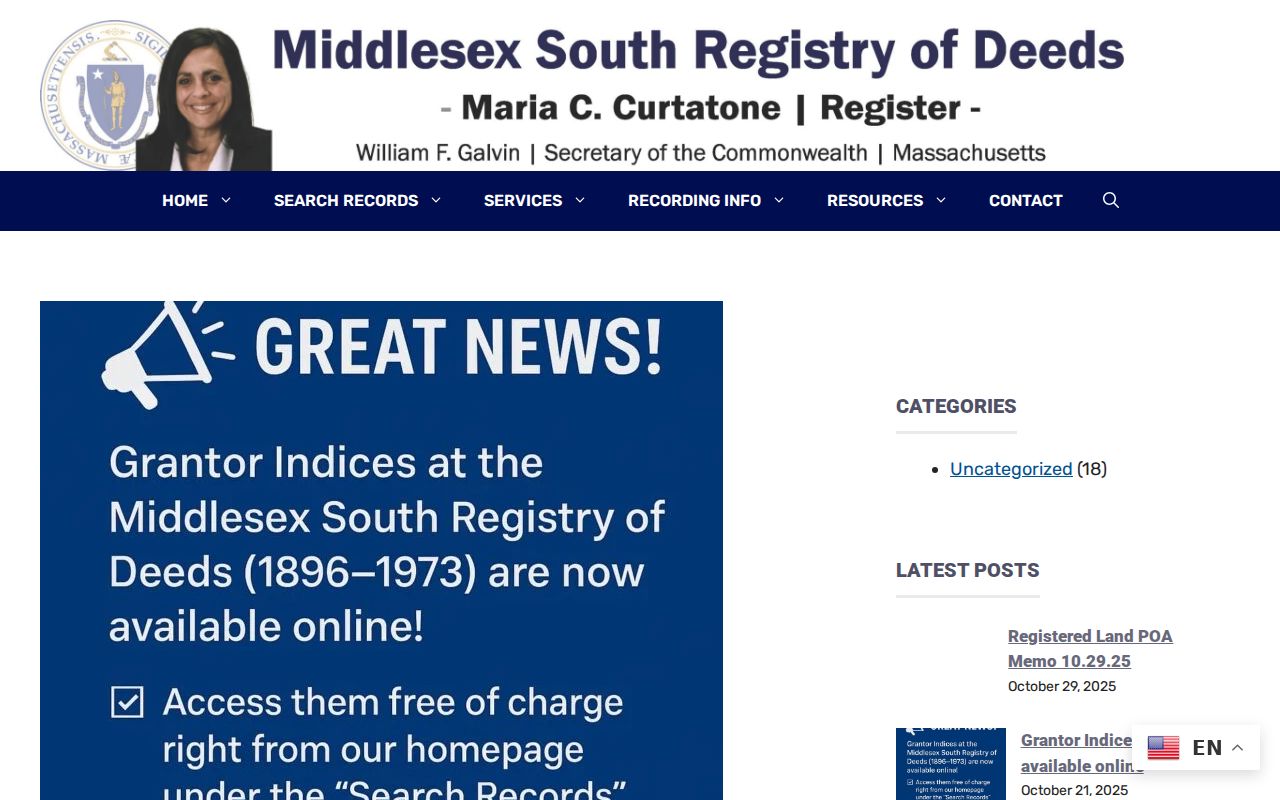
The announcement documents the expansion of the historical seller index. Record each volume, page, spelling, year range, and the deed reference found before treating it as the next link in a Winchester chain of title.
Winchester House-History Records
A deed gives an ownership transfer, while a house-history file can add the physical and civic record of the address. The Town’s materials point researchers to building permits from about 1924 onward, Engineering water-hookup cards, Historic Commission survey material, MACRIS, newspapers, assessment and plat references. A house built before that permit era may require several of those sources together.
The Town of Winchester house-history guide is the local starting point for this branch of the trail. Its pre-1920 permit caution is important: a missing permit is not evidence that no earlier structure, owner, or household existed. The 1979 Historic Commission survey covered more than 2,000 structures standing at that time, but a missing MACRIS match also does not prove a local file is absent.
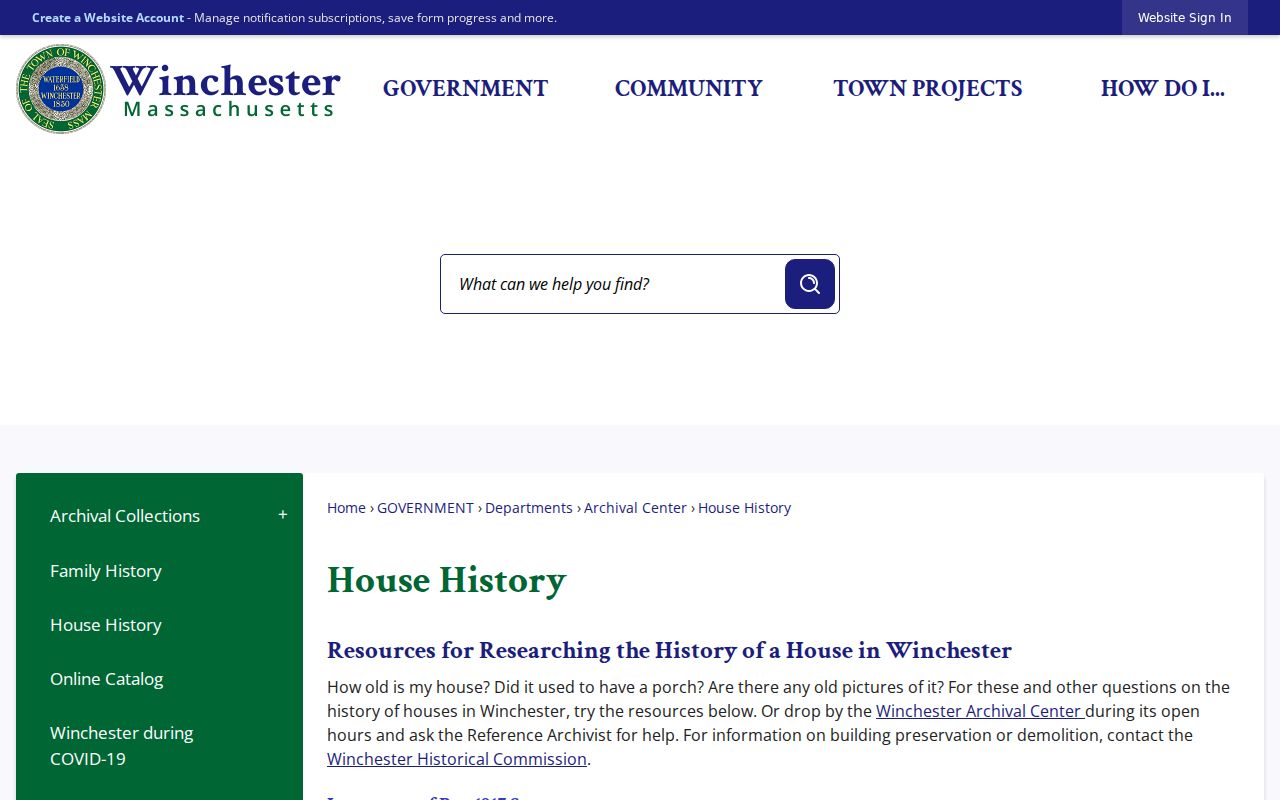
The local guide ties permits, survey evidence, municipal plans, and historic research together. Use its sources to date a property change, then compare that date with the deed and historical household record instead of relying on a single document.
Winchester Previous Residents in Lists
Previous residents are not always the recorded owners, so add historical people sources after the deed trail is stable. Winchester Blue Books and house guides cover selected years from 1895 through 1924. Library holdings also identify resident lists from 1901 through 2019 and town directories from 1950 through 2012. The Lists of Residents Over Twenty were arranged by precinct, street, and alphabetically from 1925 through 1970; the later list is for residents seventeen and older.
Consult the Winchester city directory collections for the collection-by-collection shelf and access details. A distinct local reverse or criss-cross directory run was not verified, so ask Library reference staff before assuming a volume supports address-to-person searching. A historic list may omit younger people because of its age threshold and should never be treated as a full household count.
The digitized collection search at Internet Archive is a useful access lead, although the research did not inspect a particular scan as a complete entry source.
The collection result helps locate potential volumes, not certify their contents. Compare a scanned year against the library guide and preserve the volume and page whenever it contributes to an address trail.
Lawful use. Use Winchester address history for family research, house history, estate work, and personal curiosity. Do not use historical clues to track, harass, or harm any living person.
Winchester Records Across Census Years
Use dated list and directory entries as a bridge to census research, not as substitutes for it. The local research guide identifies 1855 and 1865 Massachusetts censuses for Winchester, while released federal schedules follow the 72-year public-release rule. A list can identify an adult absent from a census household view; a census can capture people below the age threshold of a resident list.
- Place the confirmed deed or property event on a dated timeline for the address.
- Check the closest Blue Book, resident list, or town-directory year using the street, number, precinct, and name variation.
- Pair that entry with the nearest released state or federal census and preserve spelling, household, and location differences.
- Test a move with a later deed, assessor mailing clue, obituary, probate docket, or other dated primary record.
Winchester Star and Daily Times Chronicle indexes can help close a gap between records. The Library’s electronic Winchester Star obituary database covers 1985 through 2000 at the reference desk; local card indexes cover portions of earlier years. Probate can point to a fiduciary or heir, but sealed and protected material remains unavailable.
Winchester Address Continuity Checks
An older description can refer to the same land without using the modern street number. Compare lot and plan references, abutting owners, acreage, street spelling, and recorded town. For historic searching, Fruit is the earlier name for Hutchinson. Before 1850, the relevant location can appear in Woburn, Medford, or West Cambridge and later Arlington because Winchester had not yet incorporated.
Parcel splits, merged taxkeys, trust ownership, and changes in street form can create false chains. Keep a simple worksheet with the current address, parcel or PROP_ID, owner, mailing clue, book or page, date, grantor, grantee, legal description, next search term, and confidence note. If the description no longer lines up, pause the chain rather than forcing the name match.
Note: A current owner mailing address is useful for distinguishing records, but it should remain separate from the historic parcel and household timeline.